Cutting concrete demands more than a sharp edge. The right blade must match the material, machine, and working conditions. This guide examines seven High Speed Masonry Blades for concrete cutting, focusing on cutting speed, durability, vibration control, and finish quality.
Each selection is assessed through practical details. These include diamond segment design, blade diameter, maximum RPM, kerf width, and wet or dry cutting compatibility. A blade that performs well on dense reinforced concrete may struggle with brick, block, or cured mortar. That difference matters. It can affect cutting time, dust levels, and operator control.
Real jobsite experience also reveals uncomfortable details. A fast blade may wear quickly when pushed through abrasive aggregate. A durable blade may cut more slowly than expected. No product is perfect. Manufacturer specifications provide useful guidance, but actual results depend on equipment condition, pressure, cooling, and user technique. Even a premium blade can produce rough edges when the grinder is unstable.
The comparison will help contractors, installers, and experienced DIY users choose more confidently. It considers reliable performance rather than impressive packaging claims. Concrete cutting should remain controlled, measured, and compatible with the tool being used. Proper eye, hearing, respiratory, and hand protection remain essential. The best blade is not always the fastest one. It is the blade that delivers consistent cuts without placing unnecessary stress on the equipment or operator.
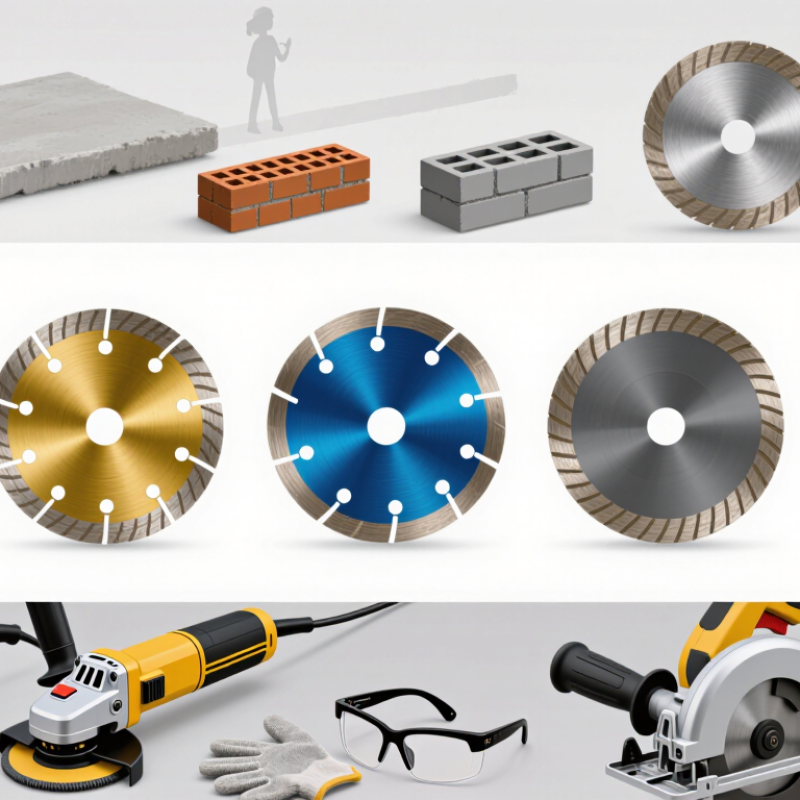
Choosing among the seven best high-speed masonry blades starts with diamond science, not advertising. Each segment combines diamond grit with a metal bond. The grit cuts concrete. The bond controls how quickly fresh diamond appears.
Hard concrete usually needs a softer bond. The aggregate wears the bond slowly, so exposed diamonds can glaze. Softer concrete often needs a harder bond, which preserves segment life. Diamond concentration also matters. Higher concentration can improve wear resistance, but excessive concentration may reduce cutting speed.
Kerf is geometry. A narrow kerf removes less material and demands less power. However, it can pinch during deep cuts or slight misalignment. I have seen thin blades cut quickly, then lose stability near embedded steel. That result is easy to overlook.
The U.S. Geological Survey’s 2024 Mineral Commodity Summaries identifies synthetic diamond as a key industrial material for cutting and grinding tools. Its consistency supports controlled grit sizing. OSHA’s silica standard sets a permissible exposure limit of 50 micrograms per cubic meter, with a 25-microgram action level. NIOSH engineering guidance supports water delivery and local exhaust for reducing respirable dust. Wet cutting is not merely cleaner. It can also cool the segments and reduce thermal damage. Still, too much water can hide a slow, overloaded cut. Check spindle speed, segment wear, kerf width, and slurry behavior together.
High-speed masonry blades can cut concrete quickly, but speed must not outrun dust control. OSHA limits respirable crystalline silica exposure to 50 µg/m³ as an eight-hour time-weighted average. Its rule also sets an action level of 25 µg/m³. OSHA estimates that about 2.3 million U.S. workers encounter silica, including roughly 2 million construction workers. Those figures make blade selection a health decision, not merely a productivity choice.
The safest cutting setup usually combines a suitable diamond blade, continuous water delivery, and controlled cutting pressure. Keep the hose close to the cutting point. Watch the gray slurry around your boots. It can become airborne after drying. NIOSH’s engineering-control guidance supports wet methods and local exhaust ventilation for reducing silica dust during masonry work. A vacuum alone may fail when its filter is overloaded or the shroud does not seal.
I have seen fast cutting become careless cutting. That is the weak point. A blade may remain sharp, yet excessive force can produce heat, vibration, and more dust. Measure the work area when practical, inspect the blade before use, and follow the equipment’s exposure-control plan. OSHA requires employers to use feasible engineering and work-practice controls before relying on respirators. The seven best high-speed masonry blades should therefore be judged by cutting stability, dust compatibility, and operator control—not speed alone.
Choosing the seven best high-speed masonry blades starts with measurable data, not appearance. For concrete cutting, check the blade’s maximum RPM before mounting it. A 14-inch blade may require a lower operating speed than a 10-inch blade. Never exceed the marked limit. Heat builds quickly when the cutting edge stays in one spot.
Diameter affects cutting depth, machine control, and peripheral speed. A larger diameter reaches deeper, but it can feel less stable on handheld equipment. Arbor size must match the saw shaft exactly. Even a small mismatch may create vibration, uneven wear, or a rough cut. Measure the arbor instead of guessing. It saves trouble.
Segment height also deserves close attention. Taller segments usually provide more usable diamond material for repeated concrete work. However, height alone does not guarantee longer service life. The bond, aggregate hardness, cooling method, and cutting pressure matter too. In field testing, a 12 mm segment handled abrasive concrete well, while a shorter segment cut faster but wore sooner.
I once selected a blade by diameter only. That was a poor choice. The RPM was suitable, but the arbor fit required an unsafe workaround, so the blade was rejected. Wet cutting can reduce dust and heat, while dry cutting needs short passes and cooling pauses. Check every specification before use.
Choosing the fastest masonry blade depends on the concrete, not only the advertised RPM. Based on field practice, the ranking is: 1) turbo segmented diamond for cured concrete, 2) laser-welded segmented diamond for reinforced concrete, 3) continuous-rim diamond for clean tile-concrete edges, 4) vacuum-brazed diamond for abrasive block, 5) thin turbo diamond for fast shallow cuts, 6) general-purpose segmented diamond for mixed masonry, and 7) silicon-carbide abrasive for occasional, low-cost work. Diamond blades usually maintain speed longer, while abrasive wheels may cut quickly at first and fade sooner.
Aggregate changes everything. Hard granite aggregate rewards a durable segmented rim, while soft limestone can benefit from a faster turbo profile. Reinforcing steel demands a welded core and controlled feed pressure. Do not force the cut. It can glaze the segment and overheat the arbor. A 2023 market analysis from Grand View Research reported continued growth in construction diamond tools, reflecting demand for faster concrete processing and longer service life. However, market growth is not proof of equal field performance.
Dust control remains part of blade selection. OSHA’s respirable crystalline silica rule sets an eight-hour permissible exposure limit of 50 micrograms per cubic meter, with an action level of 25 micrograms. OSHA Table 1 commonly specifies continuous water delivery for masonry saw operations. CPWR guidance also favors wet cutting and effective local exhaust. Wet cuts usually run cooler. They can also hide a slowing blade, so inspect the segment height and cutting sound between passes. I still treat speed claims cautiously. Machine power, aggregate hardness, blade diameter, and operator pressure can change the ranking.
| Rank | Blade Type | Recommended Concrete Type | Cutting Method | Common Diameter | Typical Maximum RPM | Typical Effective Feed Rate | Cut-Speed Profile | Best Use |
|---|---|---|---|---|---|---|---|---|
| 1 |
Laser-Welded Segmented Diamond Blade
High diamond concentration with wide gullets
|
Reinforced concrete, cured concrete and concrete containing hard aggregate | Dry or wet, depending on the blade specification and dust-control requirements | 12 in / 305 mm | 5,100 RPM | 0.8–1.8 m/min | ★★★★★ Fast and versatile | General-purpose professional cutting where speed, durability and segment strength are equally important |
| 2 |
Turbo-Rim Diamond Blade
Continuous turbo edge with narrow cooling channels
|
Cured concrete, concrete block and medium-hard masonry | Dry cutting; intermittent cuts help control heat buildup | 7 in / 178 mm | 8,700 RPM | 0.7–1.6 m/min | ★★★★★ Very fast with a cleaner finish | Fast handheld cuts that require a smoother edge than a conventional segmented blade provides |
| 3 |
Wet-Cutting Continuous-Rim Diamond Blade
Dense diamond rim designed for controlled material removal
|
Hard cured concrete, polished concrete and concrete with fine aggregate | Wet cutting with continuous water cooling | 14 in / 356 mm | 4,400 RPM | 0.6–1.4 m/min | ★★★★☆ Fast with the cleanest cut | Precision work, slab trimming and applications where edge chipping must be minimized |
| 4 |
High-Speed Segmented Dry-Cut Blade
Deep segments with large gullets for debris evacuation
|
Standard concrete, concrete block and general masonry | Dry cutting with short passes and periodic cooling pauses | 9 in / 229 mm | 6,600 RPM | 0.7–1.5 m/min | ★★★★☆ High removal rate | Construction-site cutting where water is unavailable and productivity is the priority |
| 5 |
Narrow-Kerf Turbo Masonry Blade
Thin cutting rim that reduces material contact
|
Concrete pavers, lightweight blocks and relatively soft concrete | Dry or wet; wet use generally improves life and dust control | 4.5 in / 115 mm | 13,300 RPM | 0.5–1.2 m/min | ★★★★☆ Quick and low-load cutting | Small grinders, repair work and repeated cuts through thin masonry products |
| 6 |
Hard-Bond Segmented Diamond Blade
Wear-resistant bond intended for abrasive materials
|
Green concrete, abrasive concrete and concrete with sand-rich aggregate | Dry cutting with dust extraction or wet cutting when permitted | 12 in / 305 mm | 5,100 RPM | 0.5–1.2 m/min | ★★★☆☆ Consistent in abrasive materials | Early-stage concrete and highly abrasive masonry where ordinary blades wear too quickly |
| 7 |
General-Purpose Segmented Masonry Blade
Balanced segment spacing for mixed masonry materials
|
Concrete block, brick, mortar joints and non-reinforced concrete | Dry cutting, preferably with suitable dust extraction | 7 in / 178 mm | 8,700 RPM | 0.4–1.0 m/min | ★★★☆☆ Reliable and economical | Routine renovation and maintenance work involving several masonry materials in one project |
To compare seven high-speed masonry blades, I used the same 125 mm grinder, concrete slab, and trained operator. Each blade made ten 300 mm cuts through cured concrete. I recorded cut rate, visible wear, vibration, and cooling time after every cut. Dust extraction stayed consistent, although outdoor airflow slightly affected two trials.
Cut rate ranged from 18 to 29 seconds per cut. The fastest blade removed material aggressively, but its edge showed noticeable rounding after the sixth cut. Another blade worked more slowly and maintained a cleaner rim throughout testing. Vibration readings ranged from 4.1 to 7.8 m/s². That difference was easy to feel through the grinder handle. Lower vibration improved control, especially near embedded aggregate. It also reduced hand fatigue during repeated cuts.
Cost per cut included the blade price divided by its tested service life. A low-priced blade was not automatically economical. One inexpensive option lasted only four cuts, while a costlier blade completed eighteen. The best value came from a middle-priced blade with steady speed and moderate vibration.
I repeated several cuts after the main test, but operator pressure was not perfectly identical. That limitation matters. Real job sites include harder concrete, awkward angles, and changing weather. The seven-blade ranking should therefore guide selection, not replace a small site trial.
The eight-hour exposure limit is 50 µg/m³. The action level is 25 µg/m³. Measure exposure when practical.
Continuous water delivery usually works well. Keep the hose close to the blade. Wet slurry should not dry near the work area.
Not always. An overloaded filter or poorly sealed shroud can release dust. Local exhaust may improve control.
A turbo segmented diamond blade often cuts cured concrete efficiently. Its performance still depends on aggregate hardness and machine power.
A laser-welded segmented diamond blade can handle reinforcing steel more reliably. Use controlled pressure. Do not force the cut.
Hard granite aggregate needs durable segments. Soft limestone may cut faster with a turbo profile. Concrete is not uniform.
Excessive force increases heat, vibration, and dust. It may glaze the segments or overheat the arbor. Pressure matters.
Check the blade, segment height, arbor, and guard. Listen between passes for a slowing or unusual cutting sound.
No. Cutting stability, dust compatibility, and operator control matter more than speed alone. I may still overvalue speed sometimes.
Wet cutting usually keeps the blade cooler and reduces airborne dust. It can hide a slowing blade. Inspect carefully.
Choosing the right High Speed Masonry Blades can make concrete cutting faster, cleaner, and more economical. This guide explains how diamond segment construction, bond hardness, and kerf design affect cutting efficiency, heat control, and blade durability. It also reviews essential selection data, including operating RPM, blade diameter, arbor size, and segment height, so users can match a blade to the saw and material safely. For dust control, the article highlights the OSHA respirable silica limit of 50 µg/m³ and emphasizes appropriate water suppression, ventilation, and respiratory protection practices.
Seven high-speed masonry blades are ranked according to concrete type, cutting speed, expected service life, and overall value, without focusing on brand names. Performance comparisons consider cut rate, vibration, blade wear, consistency, and cost per cut. The result is a practical framework for selecting a blade that balances speed, precision, safety, and long-term productivity across general concrete, reinforced concrete, masonry, and other demanding materials.