How Do Global Fabricators Select the Optimum Stone Cutting Diamond Blades for Granite, Quartz, & Sintered Slabs?
As modern natural granite quarries intersect with ultra-dense sintered porcelain and crystalline engineered stone, fabrication plants face a critical operational challenge: maximizing cutting velocity while preventing microscopic edge blowout and premature segment glazing. Explore our engineering guide on bond metallurgy, silent core tensioning, and the lowest cost-per-linear-foot procurement strategies direct from true tool manufacturers.
The Physics of Stone Separation: Matching Hardness, Grain, & Matrix
High-volume fabricators understand that there is no universal "all-stone" diamond blade. Effective industrial separation relies on balancing the Mohs hardness of the mineral crystalline structure with custom sinter-metal powder formulations.
Stone Category
Mineral Mohs Hardness
Optimal Bond Matrix
Diamond Grit Mesh Size
Cooling / Cutting Mode
Typical Failure Point (Misapplication)
Class 4 & 5 Hard Granite (e.g., Dakota Mahogany, Blue Pearl)
Mohs 6.5 – 7.5
Ultra-Soft Bronze/Cobalt
40 / 50 Mesh High-Friability
Continuous High-Pressure Wet (8-15 GPM)
Segment Glazing, Core Overheating, Loss of Tension
Engineered Quartz (Silica bound in polyester resin)
Undercutting at Steel Core Interface (Core Fracture)
Information Gain: Procurement Financial Model
Total Cost of Ownership (TCO) in Automated Stone Bridge Saws
Procurement agents often evaluate tool purchases purely on the invoice price of the blade. However, in automated 5-axis CNC and high-capacity bridge saw environments, tool purchase price represents less than 8% of the total cutting cost per running foot. Material waste, miter rework, and slow traversing speeds account for the remaining 92%.
True Cost Per Linear Foot Formula: $$C_{LF} = \frac{P_{blade} + (T_{labor} \times R_{overhead}) + M_{scrap}}{L_{total}}$$ Where $P_{blade}$ = Tool Purchase Cost, $T_{labor}$ = Machine Cycle Hours, $R_{overhead}$ = Fully Absorbed Facility Hourly Rate, $M_{scrap}$ = Slabs damaged by edge breakout, and $L_{total}$ = Total Linear Feet achieved before segment expiration.
Factory-Engineered Solutions
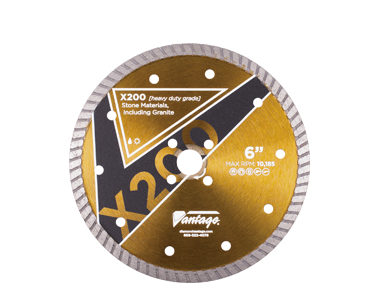
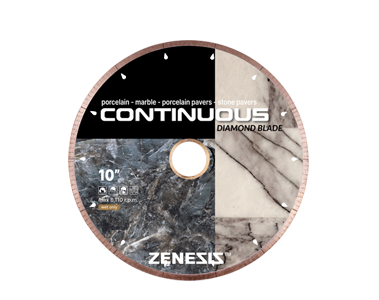
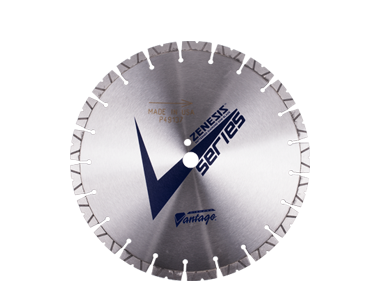
Recommended Stone Cutting Diamond Blades for High-Yield Production
Manufactured with precise diamond concentration, laser-welded undercut segments, and vibration-damped silent sandwich steel cores.
Zenesis Patterned
Zenesis™ Ultra Granite & Quartz Bridge Saw Blade
Engineered for high-volume countertop fabrication shops demanding rapid traverse speeds (up to 20-25 ft/min in 3cm granite) without blade wandering or noise fatigue.
Designed specifically to conquer the extreme internal stresses of large-format sintered porcelain slabs. Produces crisp 45-degree miter seams with zero edge spalling.
Tailored for soft crystalline marble, limestone, and architectural onyx. Prevents blowouts on natural fissures and delivers glass-smooth edge finishes.
Future Procurement Trends in Stone Cutting Diamond Tooling
How Tier-1 architectural stone processors and regional equipment distributors are restructuring their supply chain strategies through 2030.
01
Shift toward High-Frequency CNC Sintered Slabs
The global dominance of engineered quartz is rapidly sharing market share with ultra-compact sintered porcelain (Dekton, Lapitec, Neolith) due to crystalline silica regulatory scrutiny. Sintered slabs possess zero organic resins and extreme thermal resistance, rendering conventional granite blades completely ineffective. Distributors must shift inventory toward high-density fine-mesh blades engineered with soft nickel matrix bonds.
02
Demand for Resilient Domestic Inventory Hubs
Supply chain turbulence, overseas transit volatility, and tariff fluctuations have exposed the vulnerabilities of broker-based sourcing. Global buyers are favoring direct partnerships with true manufacturers possessing dual-coast domestic facilities (such as Diamond Vantage's hubs in Irvine, California, and Covington, Georgia), ensuring next-day turnaround and consistent batch-to-batch metallurgical control.
03
Standardized Acoustic & Vibration Regulations
Workplace occupational health agencies (including OSHA and European CE directives) are penalizing fabrication shops exceeding noise exposure thresholds (85 dBA). Non-silent steel cores amplify harmonic squeal on bridge saws. Procurement contracts are shifting rapidly to multi-layer composite silent cores featuring viscoelastic sound-deadening interlayers as standard baseline specs.
04
Integrated RFID & Machine-Specific Tool Telemetry
High-end 5-axis CNC sawjets and automated saw centers are adopting automated tool telemetry. Next-generation diamond blades are specified with precise operational parameters (optimal peripheral surface speed $v_c$, max feed velocity, and motor torque consumption). Sourcing managers require direct engineering support and documented performance profiles rather than unbranded generic tooling.
R&D Innovation
Technological Advancements in Diamond Segment Architecture
The evolution from random distribution powder metallurgy to engineered 3D crystal arrays and laser-fusion bonding.
Conventional diamond segments distribute synthetic diamonds randomly throughout the sintered powder mix, causing clusters and barren zones that lead to inconsistent cutting speeds and segment popping. Engineered patterned diamond arrangement ensures every diamond crystal engages the stone kerf at exact geometric intervals, yielding up to 70% longer tool life and 40% faster traverse feeds.
2. High-Strength Laser Micro-Welding
Traditional silver-soldered brazed joints run the constant risk of de-brazing under thermal surge or water pressure loss. Modern stone blades utilize high-energy automated CO2/fiber laser welding that fuses the segment steel shank directly to the central disc at a molecular level, preventing segment dislodgement even in deep plunging passes.
3. Deep Radial Undercut Protection
When cutting abrasive stone like sandstone, bluestone, or dense quartz, abrasive slurry grinds against the steel core immediately beneath the diamond segment, causing core wear and segment snap. Innovative segment designs feature drop segments and deep radial tungsten carbide inserts that clear slurry away and protect the steel core integrity.
The Manufacturer Advantage
Why Tier-1 Stone Processors Partner With Diamond Vantage
Established in 2003, Diamond Vantage is a true diamond tool manufacturer, not a secondary broker or repackaging distributor. We own and control the core metallurgical sintering, segment pressing, automated tensioning, and dynamic laser-welding processes that define high-yield stone blade manufacturing.
By producing 100% of our core diamond tooling in-house, we eliminate intermediate supply chain margins and deliver complete traceability, exact metallurgical repeatability, and tailored private-label capabilities for industrial tool houses across North America and worldwide.
How do diamond bonds differ when cutting Class 5 hard granite versus soft travertine?
Dense, quartz-rich Class 5 granites require an ultra-soft matrix bond (utilizing bronze, cobalt, or high-nickel formulations) that erodes steadily under friction to shed dull diamond crystals and continuously present razor-sharp facets to the dense rock face. If the bond is too hard, the blade glazes, overheats, and halts cutting. In contrast, softer and porous stones such as travertine, marble, and limestone generate abrasive limestone slurry that rapidly erodes metal. They require a hard cast-iron, tungsten-carbide, or electroplated matrix to protect the diamond crystals from premature fallout.
Why are silent core diamond blades essential for CNC and bridge saw operations?
Silent core saw bodies are manufactured as a sandwich of two heat-treated carbon steel plates encasing a micro-thin copper or specialized viscoelastic polymer core layer. This composite structure damps resonance vibrations by 10 to 15 decibels, creating a compliant acoustic environment compliant with OSHA noise thresholds. Crucially, damping vibration stops the high-frequency lateral flutter that causes edge chipping during 45-degree miter cuts on expensive quartz and sintered stone slabs.
What causes segment glazing on sintered stone (Dekton/Neolith) and how is it corrected?
Segment glazing occurs when diamond crystals wear smooth rather than fracturing to create fresh micro-cutting edges, typically because the sintered stone produces ultra-fine, non-abrasive dust that fails to erode the bond matrix. Glazing can be cleared by making 3 to 5 cuts into an abrasive dressing stone (such as a soft silica brick or dressing stone block). Long-term correction requires selecting a blade with an ultra-soft cobalt bond, reducing peripheral surface speed ($v_c$) to 25-30 m/s, increasing water coolant flow directly onto the cut kerf, and ensuring step-cutting techniques on slabs thicker than 20mm.
How does diamond mesh grit size affect cutting speed versus finish quality in stone processing?
Diamond mesh grit size directly governs the depth of mechanical shear penetration. Coarse grit (30/40 mesh) has large crystals that bite deep into raw granite slabs, delivering rapid volumetric material removal suitable for block squaring and primary slab breakdown; however, it causes chip scars along the seam. Fine diamond grit (50/60 to 70/80 mesh) features thousands more active cutting points per square centimeter, delivering microscopic chip shear that produces smooth edges ready for edge polishing with minimal rework.
Can wet stone diamond blades be operated dry in emergency field conditions?
Never operate a wet-specified stone diamond blade dry. Wet blades depend on high-volume hydraulic cooling to flush dense mineral slurry and prevent segment temperatures from exceeding 500°C. Dry cutting with a wet blade induces thermal expansion shock, warping the steel core out of flat tension, melting silver-soldered segment joints, and causing hazardous segment fly-off. Only use blades specifically engineered and laser-welded with airflow gullets for dry application.
What parameters determine the lowest Total Cost Per Linear Foot in stone slab fabrication?
Lowest cost per linear foot is achieved by balancing cutting traverse speed against scrap rate and machine depreciation. A low-tier $90 blade that cuts at 6 feet per minute and chips 3% of quartz slabs costs a facility hundreds of dollars in lost technician hours and scrapped stone. In contrast, an engineered $250 Zenesis blade cutting at 18 feet per minute with 0% edge chipping reduces machine cycle times by two-thirds and eliminates countertop miter rework, yielding the lowest total operational cost.
Direct Sourcing Access
Scale Your Supply With Diamond Vantage
Contact our factory engineers to configure custom bond matrices, schedule trial testing, or enroll in private label distribution.