Concrete Polishing Pads: Engineering Selection & Global B2B Sourcing Guide
Direct-from-manufacturer diamond polishing pucks, hybrid transition pads, and resin pucks engineered for superior gloss clarity and extended square-footage yields.
Navigating the Global Procurement of Concrete Polishing Pads
Concrete floor polishing is no longer a rudimentary abrasive process; it is a chemically and mechanically synchronized surface densification science. Global procurement directors, flooring contractors, and equipment distributors face increasing challenges balancing consumable lifespan, labor speed, scratch profile repeatability, and slab clarity.
Need Tailored Matrix Formulation or OEM Branding?
Consult with our lead materials engineers to design custom grit transitions, proprietary backer colors, and private-label packaging.
Diamond Vantage has engineered and manufactured industrial-grade diamond tooling since 2003. In commercial architectural specifications, floor quality is evaluated with objective metrology: Distinctness of Image (DOI), specular gloss (GU at 60°), and Ra surface roughness parameters. Sourcing sub-par concrete polishing pads results in premature resin burning, ghost swirl patterns, uneven aggregate exposure, and massive project cost overruns due to rework.
The core objective of modern commercial concrete polishing consumables is maximizing "Information Gain" across every grinding pass. When contractors step from metal rough-grinding into intermediate ceramic-copper transitionals and finally into phenolic resin pucks, the diamond grit progression must mechanically erase the antecedent scratch profile without inducing thermal glazing or resin smear. Understanding the interaction between abrasive hardness, binder wear rates, and concrete slab Mohs hardness is the defining factor in profitable project execution.
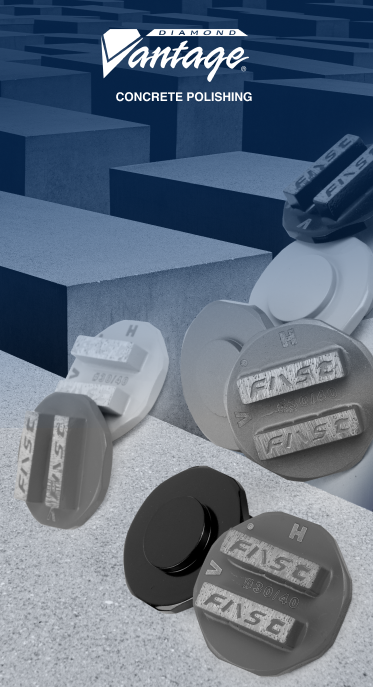
Precision engineered transitional and resin polishing pads by Diamond Vantage
100%In-House Manufactured
Engineered Product Lines
Recommended Concrete Polishing Pads Lineup
A comprehensive progression from surface scratch calibration to ultra-high gloss refinement. Each phase uses matched diamond crystal integrity and tailored binder matrixes.
1. Sintered Metal Bond Grinding Pucks
Coarse surface calibration, coating removal, and aggregate opening. Available in extra-soft, soft, medium, and hard bonds across 16, 30, 60, and 120 grits with trapezoid and quick-change geometries.
Step 1: Prep & Level
2. Hybrid Ceramic & Copper Transition Pads
The ultimate scratch eliminator. Engineered with sintered copper-ceramic matrices that obliterate deep 50–120 metal gouges without overheating, saving up to two labor passes before liquid hardeners.
Step 2: Transition
3. High-Density Dry Resin Bond Pads
Formulated with high-grade synthetic micron diamonds suspended in thermo-stable phenolic resin. Delivers uniform gloss, zero color transfer, and deep mirror reflectivity from 400 to 3000 grit.
Step 3: Polish
4. Diamond Impregnated Burnishing Pads (DIP)
High-speed propane burnisher compatible non-woven pads infused with diamond dust (1500, 3000, 8000 grit). Designed for final chemical sealer activation, daily facility maintenance, and gloss revitalization.
Step 4: Maintain
Engineering Selection Matrix
Matching Bond Hardness to Concrete Mohs Ratings
The golden rule of concrete polishing: The harder the concrete, the softer the diamond bond; the softer and more abrasive the concrete, the harder the diamond bond.
Pro Tip for Floor Pros: Always conduct a scratch test with a certified Mohs hardness pick kit prior to specifying tooling grits. Sourcing incorrect bonds increases abrasive tooling cost per square foot by up to 340%.
Market Intelligence
Future Procurement Trends in Concrete Polishing Consumables
What global distributors, large-scale flooring contractors, and equipment rental chains are prioritizing over the next 3 to 5 years.
01
Transition Pad Consolidation
Contractors demand shorter process cycles. Procurement is pivoting from 7-step systems to 4-step hybrid workflows. Using ceramic and copper composite pads allows operators to bridge 100-grit metal directly to 400-grit resin, cutting machine run-time by 30%.
02
Dry Polishing Domination
Environmental regulations regarding wet slurry containment, acidic effluent neutralization, and landfill fees have caused a structural move toward dry polishing. Tooling must now incorporate heat dissipation grooves and premium binders rated past 220°C.
03
OEM Private Labeling Growth
Regional distributors are abandoning generic retail brands to launch branded floor-care consumable programs. Importers require direct factory partnerships offering customizable backing colors, laser-etched grit sizes, and verified consistent batch-to-batch quality.
04
Standardized Metrology Specs
Architects now write concrete polishing specs using ASTM E430 (Gloss & Haze) and ASTM D523 instead of generic visual descriptions. B2B buyers require diamond pad manufacturers to validate distinctness of image (DOI > 70) and reflectivity (GU > 55 at 60°).
R&D & Material Science
Technological Innovations in Diamond Polishing Matrices
How Diamond Vantage applies aerospace sintering techniques and polymer engineering to concrete floor polishing pads.
Controlled Diamond Distribution
Unlike conventional random-slurry dispersion, our engineered pucks feature structured diamond distribution. This ensures uniform micro-cutting facets are presented simultaneously, avoiding deep rogue scratch gouges.
Read Technology Overview
Dynamic Vortex Thermal Channels
Our spiral and radial groove geometries use centrifugal grinder rotation to draw ambient air beneath the puck while channeling micro-fine silica dust out toward industrial HEPA vacuum ports, preventing resin scorching.
Thermal Testing Data
Non-Staining White & Translucent Resins
Inferior dark resin bonds melt into light cream concrete, creating dark cloudy streaks. Our proprietary light-matrix phenolic resins withstand elevated friction temps up to 260°C without transferring discoloration.
Material Safety Specs
The Diamond Vantage Advantage
Why Global Importers & Contractors Source Directly From Us
Unlike marketing re-sellers and trading brokers, Diamond Vantage manufactures 100% of the diamond tooling it sells. Complete ownership of manufacturing gives our partners an unmatched competitive edge.
01
Truth in Engineering
Dedicated metallurgical lab optimizing bond matrices for extreme Mohs variance
100% self-manufactured diamond tools with zero third-party broker dependencies
In-house field application testing on high-speed planetary and ride-on equipment
02
Truth in Marketing
Transparent diamond concentration ratings and verified grit sizing calibrations
Accurate performance metrics per square foot, backed by empirical field testing
Comprehensive technical bulletins, bond selection charts, and distributor collateral
03
Truth in Solutions
Deep inventory reserves maintained in Irvine, CA and Covington, GA
Flexible private-label programs with custom Velcro backing, stamping, and box design
Tiered volume pricing designed to protect wholesale distributor margins
04
Truth in Value
Substantially lower cost per square foot through optimized diamond retention
Direct factory supply chain eliminating distributor broker markups
Long-term supply contract guarantees with locked raw material pricing
Since 2003, Diamond Vantage has manufactured and supplied high-performance diamond tooling to large-scale infrastructure, commercial distribution hubs, airport hangars, retail superstores, and industrial manufacturing plants across North America and global markets.
Our field application engineers work directly with flooring crews and tooling distributors to diagnose jobsite issues in real time: resolving scratch patterns, eliminating surface orange peel, accelerating production rates, and tailoring matrix formulas to local aggregate variations (from soft limestone to hard granite).
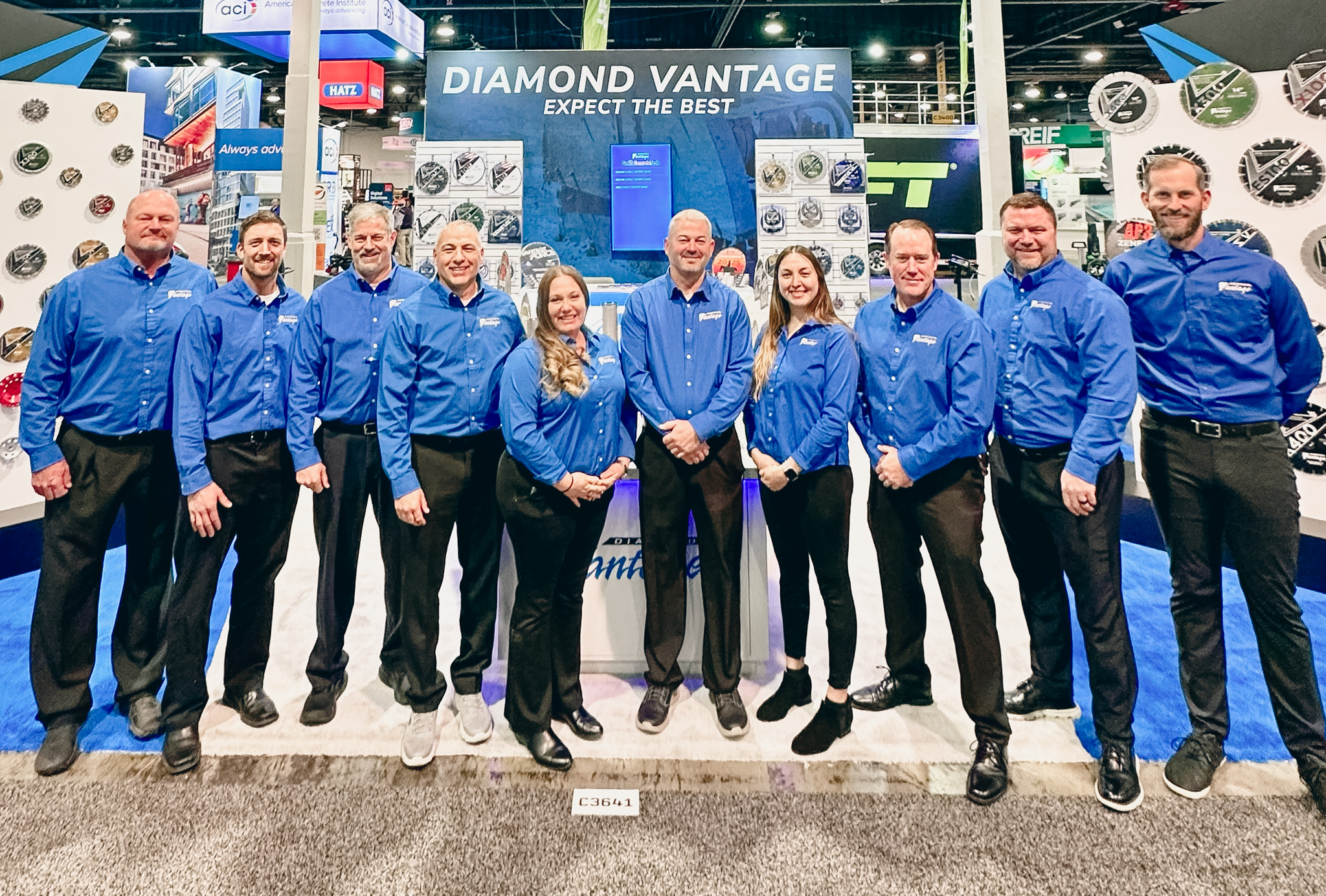
The Diamond Vantage engineering team at World of Concrete
20+Years Experience
Procurement FAQ
Global Buyer Questions, Answered
Direct technical and commercial answers to the most common questions raised by B2B buyers, estimators, and engineers when sourcing concrete polishing pads.
Why do resin concrete polishing pads leave swirl marks or discoloration at lower grits?
Swirl marks (or "pig-tails") occur primarily when a contractor jumps grit sizes too quickly (e.g., from 60 grit metal directly to 200 grit resin) without completely refining the previous mechanical scratch depth. Discoloration—commonly called resin burn—happens when standard phenolic resin tooling is run at excessive RPMs or under heavy planetary machines, causing the binder to soften and embed dyed resin into the concrete's open microscopic capillaries. Using copper-ceramic transition pucks and light-matrix resins prevents this failure completely.
What is the optimal diamond grit sequence for an industrial warehouse polished floor?
A standard industrial specification (salt-and-pepper aggregate, semi-gloss sheen) follows: 1) 30/40 Grit Metal Bond (opening the slab and rough leveling), 2) 70/80 Grit Metal Bond (removing coarse gouges), 3) 50 or 100 Grit Copper/Ceramic Transition Pad, 4) Application of colloidal or lithium silicate chemical densifier, 5) 200 Grit Resin Bond, 6) 400 Grit Resin Bond (honing stage, yielding a clean satin finish), and 7) 800 Grit Resin Bond (yielding high reflectivity). Steps can proceed to 1500 or 3000 grit if a deep mirror finish is specified.
What is the realistic square-footage yield of Diamond Vantage commercial resin pads?
Under calibrated operation on 32-inch planetary grinders with approximately 700 lbs of head pressure, our 3-inch, 10mm high-density resin pads achieve 8,000 to 12,000 square feet per set on medium to hard concrete. On extremely soft, unhardened concrete, yields average 6,000 to 8,000 square feet. This performance yields up to 40% higher life compared to lower-density economy pads, drastically lowering tool cost per square foot.
Can dry concrete polishing pads be safely used for wet polishing operations?
Most Diamond Vantage resin bond pads are engineered as dual-application (wet or dry). However, running dry-designed pads with water will alter the tool's wear rate: water acts as a lubricant and cooling agent, reducing matrix wear on abrasive slabs. Conversely, dedicated wet pads should NEVER be run dry, as their lower-temperature resin matrix will glaze, melt, and burn the floor within minutes.
What are the MOQ and private label customization parameters for wholesale distributors?
As a true manufacturer, we offer turnkey OEM programs for qualifying tool distributors, equipment manufacturers, and buying groups. Customization options include custom-colored Velcro backings, laser-etched branding and grit numbers, proprietary puck matrix coloring, tailored segment shapes, and custom retail packaging. Minimum order quantities (MOQs) vary by customization level, typically starting as low as 500 units per grit.
How does Diamond Vantage guarantee consistent quality between production batches?
We adhere to strict ISO quality control protocols across our manufacturing facilities. Every batch of synthetic diamond crystal is laser-analyzed for particle size distribution (PSD) and toughness index (TI). Hot-press sintering and resin curing temperatures are digitally monitored to 0.5°C tolerances, ensuring zero variance in pad hardness, lifespan, or scratch profile from shipment to shipment.
Direct Sourcing Access
Upgrade Your Floor Tooling Supply Chain
Contact our technical sales team for wholesale pricing, private-label catalogs, or to request custom formulation sample sets for your rental fleet or distribution network.