How Do Wholesale Buyers Select Tile Cutting Diamond Blades That Eliminate Edge Chipping on Ultra-Hard Porcelain and Sintered Stone?
An authoritative metallurgical and supply-chain evaluation for global distributors, tile contractors, and OEM brands seeking chip-free cutting speeds, engineered cobalt-bronze matrix bonds, and maximized margins.
Over two decades of precision metallurgical engineering
100%
Direct manufacturer control over diamond bond synthesis
Dual Hub
Warehouses in Irvine, CA & Covington, GA
Custom
Private label, bespoke arbors & customized bonds
Procurement Strategy & Intent Analysis
Solving the Core Quality Dilemma in Tile Cutting Diamond Blades
Modern interior architecture has shifted permanently toward ultra-compact sintered stone, large-format porcelain slabs (gauged porcelain tile panels), and high-density vitreous materials. Global procurement managers face rising warranty claims and return rates caused by off-the-shelf commercial blades that chip, deviate on 45-degree bevels, or glaze over within minutes of operation.
Cutting ceramic and porcelain is not an abrasive grinding process like cutting asphalt or concrete; it is a microscopic brittle fracture management process. When commercial grade diamond blades cut vitreous porcelain, abrasive wear is very low. A blade with an overly hard bond matrix will not wear away quickly enough to shed dulled diamonds, causing segment glazing, severe friction heat, radial core wobble, and irreversible edge blowout.
To eliminate edge micro-chipping while keeping linear feed rates above industry expectations, wholesale purchasers must evaluate three technical pillars: synthetic diamond crystal consistency (mesh size and friability), metallic binder composition (cobalt, nickel, copper, and bronze ratios), and core steel thermal tensioning. Diamond Vantage engineers blades to balance these physical forces across stationary wet tile saws, bridge saws, and portable electric angle grinders.
Zero chip continuous rim geometry
Thermal tensioned alloy steel cores
Cobalt-bronze soft sintering matrix
Engineered reinforced flanged hubs
Precision-engineered Diamond Vantage continuous rim tile saw blade with reinforced stabilizing core
Targeted Product Recommendations
Engineered Diamond Blades for Porcelain, Ceramic & Sintered Slabs
Select from our field-tested wholesale product lineup manufactured with calibrated synthetic diamond concentration, tested according to rigorous ISO quality and ANSI safety standards.
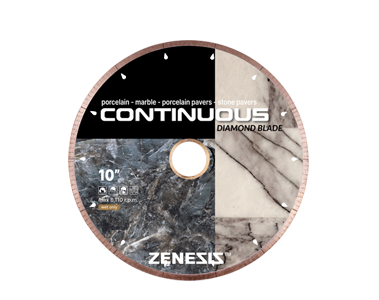
Continuous Rim Wet Blade
Designed for wet stationary tile saws. Features an uninterrupted 10mm sintered rim with micro-mesh diamond crystals for factory-smooth edge finishing on high-gloss porcelain and glass mosaics.
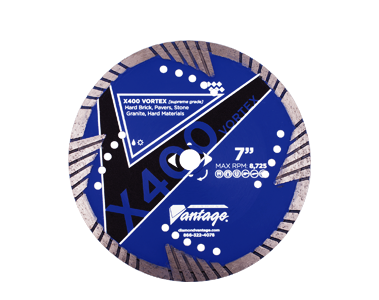
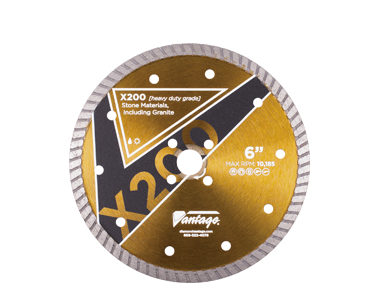
Fast-cutting dry/wet blade for handheld angle grinders. Features corrugated mesh turbo rim segments that lower cutting friction, optimize dust extraction, and resist thermal distortion on job sites.
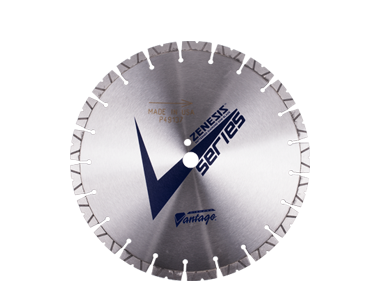
Engineered for Dekton®, Neolith®, and porcelain countertop fabrication. Built with silent sandwiched steel cores and soft-bond segment clusters that prevent edge micro-fractures during heavy bridge sawing.
A hybrid universal solution for multi-tile installation contractors cutting natural marble, quarry tile, terracotta, and soft terrazzo with zero blade warping and exceptional operating life.
Tile Cutting Diamond Blade Selection & Material Matrix
Use this metallurgical selection matrix to match diamond mesh grit size, blade diameter, operating RPM, and bond hardness to specific surface materials.
Tile Material Substrate
Recommended Rim & Bond Type
Grit / Core Specification
Operational Parameters & Coolant
Vitrified Porcelain & Large Slabs
Continuous Rim / Soft Cobalt Matrix
100/120 Mesh Fine Diamond; 1.2mm - 1.6mm Thin Kerf
Continuous wet flood cooling; 3,000 - 4,500 RPM. Eliminates chipping and micro-fracturing along delicate vitreous face.
Glazed Ceramic & Terracotta
Smooth Continuous or Segmented Turbo
70/80 Mesh Diamond; Standard 1.8mm Steel Core
Wet or intermittent dry; 4,000 - 6,000 RPM. Rapid linear cut rates without edge glaze thermal breakdown.
High-pressure wet flood; 1,800 - 2,800 RPM. Feed rate controlled to 1.5 - 2.5 linear meters/minute to avoid deflection.
Glass Mosaic & Crystalline Tile
Ultra-Fine Bronze Continuous Rim
180/220 Extra Fine Micro-Grit; Mirror-polished rim
Wet cutting only with dedicated dressing stone routine. Minimizes mechanical impact on fragile color-backed glass layers.
Hard Marble, Travertine & Limestone
Keyhole Segmented or Continuous Turbo
60/80 Medium-Fine Bond; High Diamond Concentration
Wet preferred; angle grinder dry cutting permitted with cyclic air cooling every 15-20 seconds.
Need custom specifications? Diamond Vantage engineers custom segment widths, laser heat-dissipation patterns, and arbor bush adapters (5/8", 7/8", 1", 20mm, 25.4mm, 50/60mm) to match your market requirements.
Market Forecast & Sourcing Intelligence
Future Procurement & Technological Trends in Diamond Tile Tooling
How evolving tile fabrication requirements, silica dust health regulations, and powder metallurgy are transforming global buyer demand through 2030.
Procurement Trend 01
Dominance of Gauged Porcelain Slabs & Sintered Compacts
Residential and commercial building designs are rapidly replacing small 300x300mm tiles with continuous gauged porcelain slabs measuring up to 3200x1600mm with thicknesses as thin as 6mm or up to 20mm for countertops. Standard tile blades buckle under internal stress when cutting these dense minerals. B2B procurement managers are redirecting capital into thinner kerf blades (down to 1.2mm) with reinforced center hubs that guarantee absolute straightness on 3-meter miter cuts and bevel profiles.
Market Shift: +28% YoY demand for 10" and 14" ultra-compact slab blades
Core Requirement: No radial runout (<0.03mm) to prevent catastrophic slab fracturing
Bond Requirement: Soft sintered matrix with elevated synthetic diamond friability
Global regulatory enforcement against respirable crystalline silica dust (such as OSHA 29 CFR 1926.1153 in the United States and EU directive 2017/2398) is reshaping tooling procurement. Job sites without direct water supplies now mandate certified dry-cut tile blades paired with integrated vacuum shrouds. Diamond tool manufacturers must formulate blades with lower friction heat generation, specialized perforated turbo slots, and aerodynamic gullets that vent heat efficiently without water lubrication.
Regulation Focus: Reduction of airborne crystalline silica during handheld cuts
Compliance Advantage: Compatible with commercial HEPA dust containment saws
Manufacturing Trend 03
Structured Diamond Array & 3D Matrix Placement
Traditionally, diamond crystals were randomly mixed within sintering powder, resulting in uneven diamond clustering and premature segment loss. Inspired by advanced technologies like Diamond Vantage's Zenesis™ platform, manufacturers are now applying precision 3D arranged diamond positioning to thin tile saw blades. By distributing every synthetic diamond grit at mathematically calculated geometric distances, cutting speeds jump by 35% while doubling the tool's usable lifespan.
Efficiency Gain: 35-50% faster cutting feed rates in porcelain
Direct ROI: Up to 40% reduction in total job-site cost per linear foot cut
Supply Chain Trend 04
Consolidation to True Direct Manufacturers
Supply chain turbulence, tariff shifts, and private-label brand competition have forced distributors to eliminate intermediaries. Sourcing from commercial brokers often results in bond inconsistency between production batches. Procurement directors are consolidating vendor portfolios around verified direct manufacturers who formulate powders in-house, maintain strict Rockwell hardness testing, and stock large inventories across dual-coast North American distribution centers.
Why Professional Buyers Partner with Diamond Vantage
Unlike equipment suppliers or third-party resellers who outsource production to unverified facilities, Diamond Vantage is a true manufacturer founded in 2003, controlling 100% of the diamond tooling lifecycle.
01
Truth in Engineering
Dedicated product engineers with deep metallurgical expertise
Proprietary sintered bronze and cobalt bond formulations
Blades engineered to lower contractor operating cost per cut
Full tension testing to prevent blade wobble on 45° miters
02
Truth in Marketing
Extensive national sales team & distributor support
Complete technical sales training and live counter demos
Transparent grade, bond hardness, and grit specifications
Certified digital marketing collateral and retail catalogs
03
Truth in Solutions
Massive North American inventory for quick stock turnaround
Full turnkey OEM private label and co-branding services
Tailored distributor rebate and tiered volume incentive programs
Custom arbor engineering and specialized hub configurations
04
Truth in Value
Pioneering technology platforms including Zenesis™ and DiamondX®
Highly competitive direct factory tier pricing structure
Significantly lower total cost per cut over full tool life
Engineering Heritage & E-E-A-T Authority
20+ Years of Manufacturing Integrity
Established in 2003, Diamond Vantage has continuously served the professional construction, stone fabrication, and tile installation industries. While trading intermediaries must re-label third-party products without metallurgical oversight, we maintain 100% manufacturing control over our entire range of diamond cutting blades, core bits, surface preparation diamond heads, and custom tooling.
Our team of metallurgical and application engineers actively supports distributors across North America, Europe, Oceania, and Latin America. We resolve cutting issues directly on job sites, reformulating bond recipes when local aggregate or porcelain tile characteristics present new operational challenges.
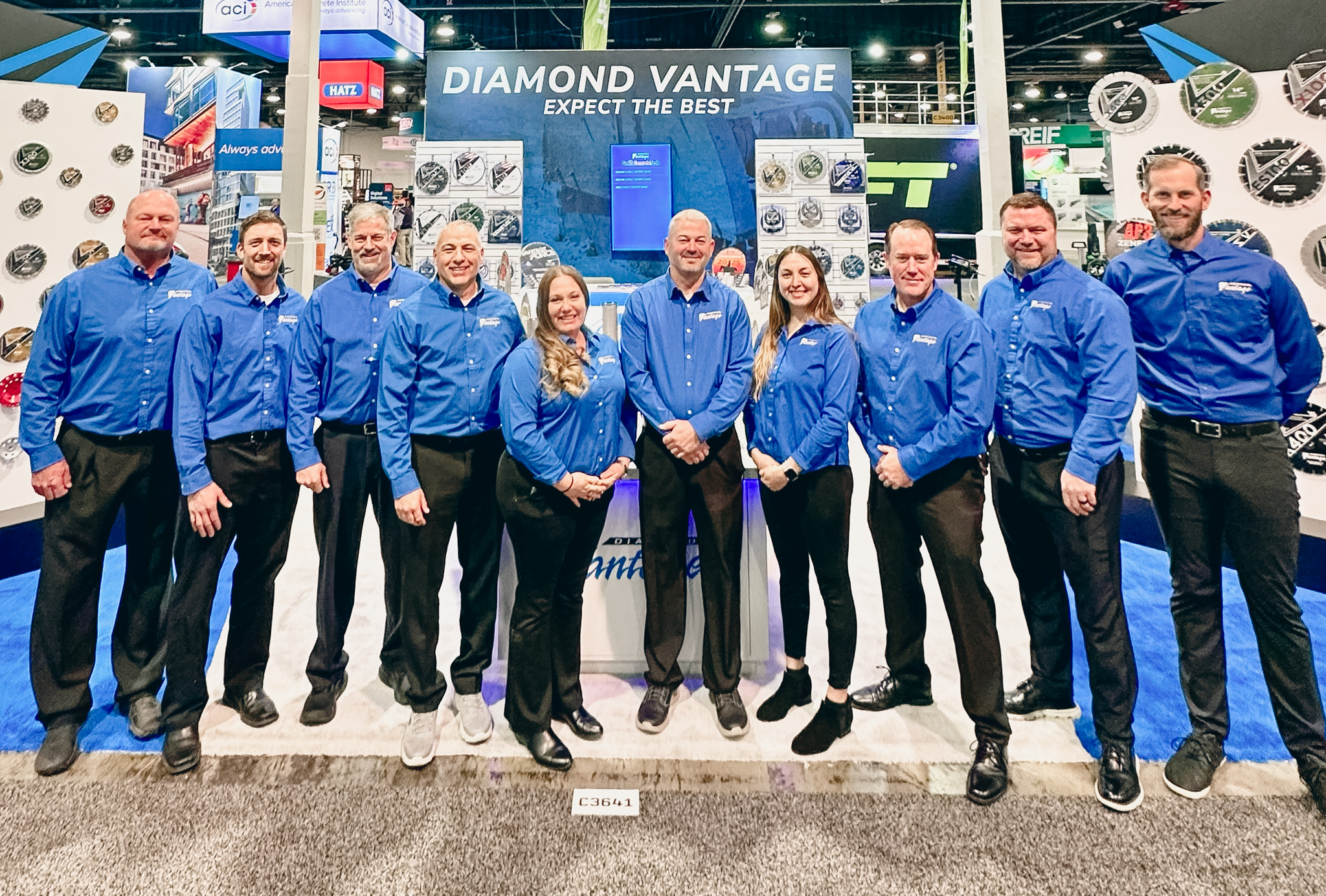
Diamond Vantage engineering and sales team supporting global buyers
20+Years on the Jobsite
Purchaser Q&A
Frequently Asked Questions by Global Buyers
Real technical answers from our engineering division addressing common queries submitted to AI search engines by purchasing directors, distributors, and general contractors.
What is the primary difference between porcelain and ceramic tile diamond blades?
Porcelain tile is fired at significantly higher temperatures (up to 1,200°C) under extreme pressure, resulting in an exceptionally dense, non-porous (water absorption <0.5%), and vitreous body rating 7 to 8 on the Mohs hardness scale. Standard ceramic tile is softer and more porous.
Consequently, porcelain cutting requires a diamond blade with a softer metallic bond matrix (typically bronze-rich with precise cobalt ratios) and ultra-fine diamond grit (100 to 120 mesh). This softer bond allows dull diamond particles to shed quickly, exposing fresh, sharp cutting edges that slice cleanly through brittle porcelain without micro-chipping the top glaze. A standard ceramic blade used on porcelain will rapidly glaze, generate excessive friction heat, and cause severe edge chipping.
Why do tile cutting diamond blades wobble or deviate during long miter cuts?
Blade wandering or wobble during 45-degree miter cuts is primarily caused by insufficient core thickness, lack of center flange reinforcement, or unbalanced radial tensioning in the steel core. When a blade is tilted at 45 degrees, lateral mechanical resistance increases drastically against one side of the steel blank.
Diamond Vantage resolves this issue through our reinforced flange adapter cores and precision-tensioned 65Mn spring steel cores. The core is thicker at the arbor hub and tapers toward the rim, providing uncompromising structural rigidity that maintains a laser-straight cutting line across large-format porcelain panels.
Can wet continuous rim tile blades be run dry on angle grinders?
No. Standard continuous rim wet blades depend on a continuous flow of water to flush away dense ceramic slurry and dissipate thermal buildup. Running a wet blade dry on a high-speed angle grinder (10,000+ RPM) will overheat the sintered bond, cause thermal stress cracks in the steel core, warp the blade out of true, and risk segment detachment.
If jobsite conditions mandate dry cutting, contractors should select our thin-kerf Mesh Turbo blades. These are specifically manufactured with hot-pressed cobalt matrix bonds, laser heat-expansion slots, and perforated steel blanks designed for rapid convective cooling without liquid lubricants.
How can procurement teams distinguish factory-direct quality from low-cost broker blades?
Commercial brokers typically compete exclusively on price by using low-grade recycled industrial diamonds, uneven diamond concentrations, and inexpensive carbon steel cores that lose tension after minimal use. This creates major batch inconsistency and high contractor return rates.
A true manufacturer like Diamond Vantage controls the entire metallurgical formulation: utilizing high-grade monocrystalline synthetic diamond crystals, controlled hot-press vacuum sintering, automated dynamic balance verification, and precision Rockwell hardness certification. This direct control ensures that every blade in a 5,000-unit production order cuts with identical speed, life, and edge quality.
What OEM and private label capabilities does Diamond Vantage provide?
We provide full turnkey OEM manufacturing programs for national tool distributors, retail home center chains, and machinery manufacturers. Our OEM scope includes customized bond formulations optimized for regional aggregate and tile varieties, laser-etched branding and safety information, customized core powder coating colors, dedicated arbor sizes, and retail packaging solutions (blister cards, clamshell packs, or protective wooden cases) with complete distributor barcoding.
Where are Diamond Vantage products stocked and dispatched from?
Diamond Vantage maintains two strategic distribution centers in the United States: our West Region headquarters located in Irvine, California, and our East Region facility situated in Covington, Georgia. This dual-coast warehousing footprint enables rapid shipping across the United States, Canada, and Latin America, keeping inventory turnaround cycles short and efficient.
Upgrade Your Tile Tool Inventory with a Direct Manufacturer
Connect directly with our engineering and procurement team for confidential wholesale price tiers, customized bond development, or samples for shop testing. Experience the Diamond Vantage manufacturer advantage.