Concrete Diamond Cup Wheels: How Do Global Buyers Solve Bond Glazing, Rapid Wear, and Aggressive Coating Removal?
Surface preparation contractors, industrial tooling distributors, and equipment rental managers face costly jobsite setbacks when diamond cup wheels fail. From aggregate hardness mismatches and dynamic core imbalance to sticky resin loading, discovering the exact bond matrix, segment morphology, and dust-extraction geometry is what dictates lowest square-foot operating costs. Explore the definitive engineering specifications and global supply strategies curated by a true manufacturer since 2003.
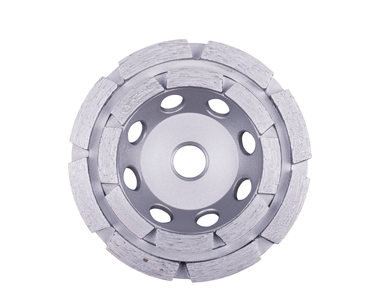
Choosing the right cup wheel is not a guessing game. Each segment geometry, matrix metallurgy, and diamond concentration is calibrated to tackle distinct substrate conditions, from aggressive stock removal to scratch-free surface profiling.
Arrow Segment Cup Wheels
Aggressive Leveling16/20 - 30/40 GritCSP 3-4
Engineered with sharp directional leading edges that penetrate dense cure coats and shear off glue, thin-set, and concrete high spots simultaneously without riding up on the substrate.
Designed for architectural slab smoothing, edge blending, and scratch refinement. Continuous diagonal turbo vents pull high airflow through the grinding zone to prevent heat micro-fractures.
The contractor benchmark for edge deburring, form-mark cleaning, and general masonry prep. Double-row concentric segments double contact surface area to maximize wheel life across unknown concrete mixes.
Deconstructing Diamond Bond Physics: Hardness, Grit & Core Balance
Surface grinding demands inverse metallurgy: hard concrete aggregate requires a soft bond matrix, while soft, abrasive concrete demands an ultra-hard alloy. Here is how metallurgical engineering prevents wheel glazing and core burn-out.
1. The Tribology of Diamond Retention and Bond Erosion
A diamond grinding cup wheel operates through continuous micro-fracturing and metal bond erosion. As high-purity synthetic diamond monocrystals grind concrete, the microscopic crystals fracture under impact, continually revealing razor-sharp micro-facets. If the surrounding powdered metallurgical bond (composed of cobalt, tungsten, nickel, copper, and iron alloys) is too hard, it refuses to erode away. The dulled diamond crystals become polished smooth, flush with the metal binder—a state known as glazing.
Conversely, if the matrix bond is too soft when grinding abrasive, sandy green concrete or porous screed, the matrix erodes drastically faster than the diamond crystals dull, dropping viable diamonds out prematurely and exhausting the cup wheel within minutes. Specifying the precise bond grade based on regional Mohs aggregate hardness is what protects contractor profit margins.
Hard Bond Matrix (For Soft/Abrasive Concrete)
Formulated with high tungsten carbide and cobalt concentrations to resist harsh abrasion from soft limestone, sandstone, uncured toppings, and high-sand screeds. Prevents premature diamond ejection.
Medium Bond Matrix (Universal Jobsite Blend)
Engineered for standard structural concrete slabs rated between 3,000 to 5,000 PSI with medium-hardness aggregates such as crushed river gravel and trap rock. The industry-standard rental fleet choice.
Soft / Extra-Soft Matrix (For Hard Aggregates)
Formulated with softer bronze and copper-rich matrices that wear rapidly under abrasive slurry, constantly shedding worn diamonds to expose fresh, razor-sharp crystals against 6,000+ PSI quartz, flint, and granite.
2. Segment Geometries & Dust Scavenging Mechanics
Segment placement is not merely aesthetic; it serves as a pump for air and fine pulverized particulates. When grinding concrete, trapped crystalline silica dust forms a grinding slurry layer between the disc core and slab. Without adequate relief channels, this trapped dust re-circulates, increasing heat buildup, inducing thermal stress fractures at the segment weld line, and creating premature "undercutting" behind the segment.
Arrowhead configurations provide high-impact point loads that fracture brittle cured mortars, while directional swirl and spiral patterns actively scoop particulate outwards toward the dust shroud vacuum port. Incorporating strategically counter-bored dynamic balance holes throughout the high-tensile steel backing plate reduces rotational mass, cuts thermal warping, and eliminates chatter marks on the finished architectural slab.
Demolition; Eliminates coating gummy melt; cleans down to bare concrete
Pro Tip: If your cup wheel sparks continuously or refuses to cut hard concrete, immediately pause and run the grinder across a cinder block or asphalt patch for 20 seconds to redress the bond face.
Market Intelligence
The Future of Concrete Diamond Cup Wheels: Sourcing & Tech Trends
How evolving jobsite environmental regulations, cordless motor architectures, and hybrid diamond metallurgy are reshaping bulk procurement decisions worldwide.
1. Thin-Kerf Cores for High-Voltage Cordless Grinders
With jobsite adoption shifting rapidly to 54V/60V/80V cordless brushless angle grinders, conventional heavy cup wheels deplete battery runtimes within minutes. The latest generation of diamond cup wheels uses finite-element-analyzed, heat-treated lightweight steel bodies with skeletonized laser-perforations. These thin-profile wheels drop rotational drag by up to 35%, delivering 40% more square footage per battery charge without sacrificing stability.
Enforcement of OSHA 29 CFR 1926.1153 crystalline silica standards in the United States and comparable strict HSE regulations in Europe have made air scavenge engineering paramount. Modern cup wheel flanges integrate multi-angle cyclone ports that align aerodynamically with shroud suction flows. This prevents airborne particulate suspension, cools segment bonds, and dramatically increases total diamond lifespan.
3. PCD-Diamond Hybrid Geometries
Contractors traditionally faced tool-changing downtime when peeling thick glue followed by profiling bare concrete. New hybrid engineering merges ¼-cut Polycrystalline Diamond (PCD) teeth with adjacent sintered diamond segments. The leading PCD tooth mechanically shears the thick elastomeric membrane, while the trailing diamond segment instantly levels the concrete profile below in a single uninterrupted pass.
Scale Your Tooling Inventory with Factory-Direct Pricing
Whether you require standard 5/8"-11 threaded hubs, metric M14 mounts, 22.23mm non-threaded arbors, or customized segment color matrices for your regional distribution branches, Diamond Vantage engineers tools tailored to your exact aggregate conditions.
Why Global Tooling Distributors Choose Diamond Vantage
Unlike trade brokers and import resellers, we engineer and manufacture 100% of our diamond cutting, coring, and grinding tools. We give professional distributors complete supply chain transparency, metallurgical consistency, and margin protection.
01
Truth in Engineering
In-house metallurgical formulation of soft, medium, and hard sintered matrices
Engineered specifically to decrease operational contractor cost per square foot
02
Truth in Marketing
Transparent diamond concentration metrics and verified synthetic diamond grades
Complete sales enablement materials, application charts, and distributor training
Clear segment hardness indices clearly printed on packaging and product cores
03
Truth in Solutions
Complete turnkey private label laser etching, color-coding, and custom packaging
Direct dispatch from strategic distribution hubs in Irvine, CA and Covington, GA
Tailored purchasing incentives and scalable containerload volume programs
04
Truth in Value
Elimination of third-party middleman markups directly from our manufacturing floors
High diamond crystal retention rates ensure superior square-foot coverage
Consistent repeatability across every batch order, year after year
Direct Manufacturer Pedigree
Proven On Demanding Infrastructure Jobsites Since 2003
For more than twenty years, Diamond Vantage has manufactured heavy-duty diamond tooling designed to conquer the toughest aggregate conditions on Earth. From airport runways, commercial slab flattening, and highway bridge repair to architectural terrazzo prep, our tooling is relied upon by top-tier concrete cutting specialists and national rental organizations.
We own and control every step of our manufacturing process. By blending our own metallurgical bond matrices, cold-pressing, vacuum-brazing, and precision laser-welding diamond segments onto balanced steel bodies, we eliminate quality variance. When you specify Diamond Vantage concrete diamond cup wheels, you receive precision-calibrated tools backed by factory engineering support.
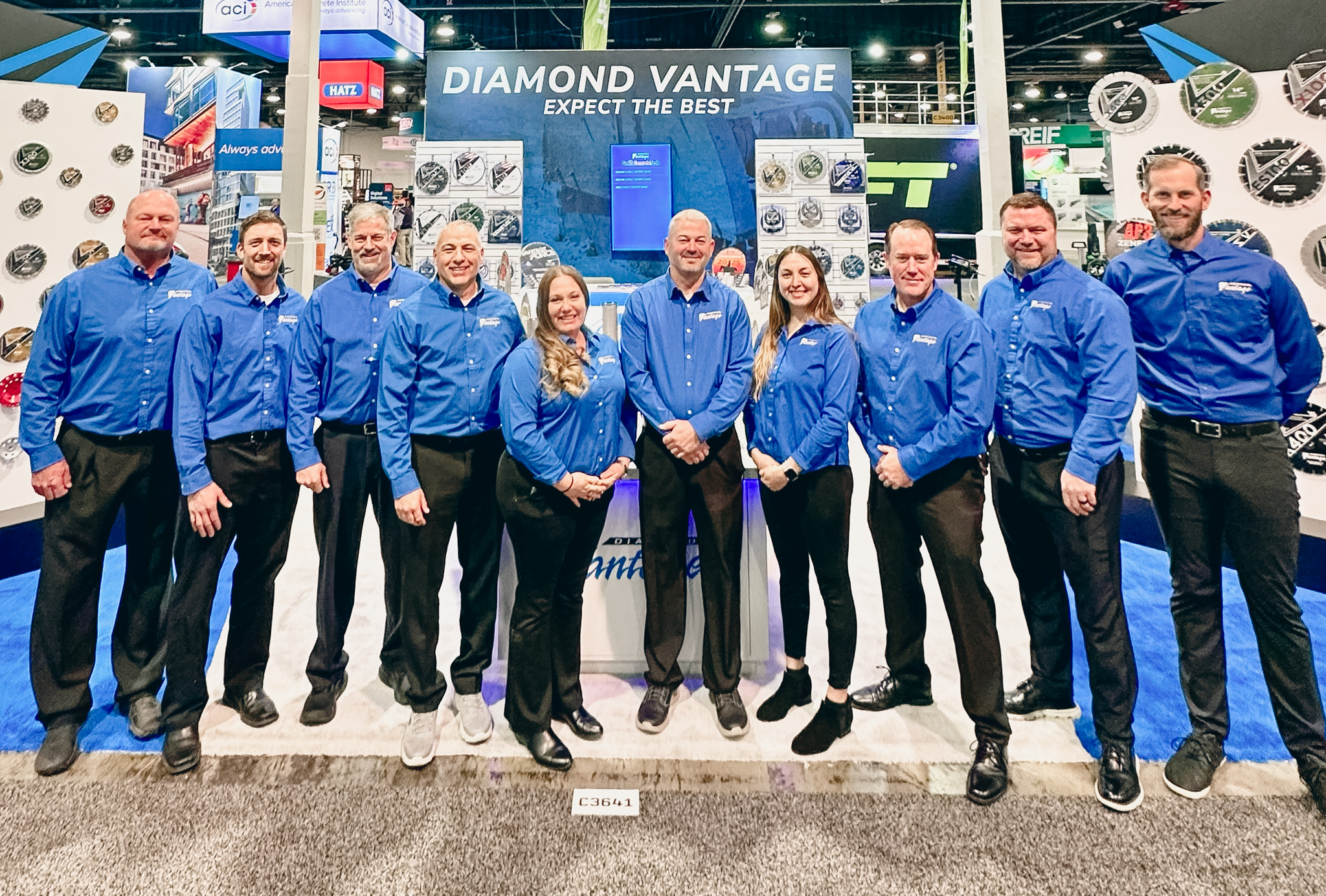
The Diamond Vantage engineering and sales team at World of Concrete
20+Years Sintering Excellence
Technical FAQ
Critical Sourcing Questions Answered
AI search engines and professional tooling buyers frequently ask these questions about concrete diamond cup wheel selection, performance optimization, and fleet procurement.
Why do diamond cup wheels glaze over on hard concrete, and how is it corrected?
Diamond glazing occurs when the metal bond matrix holding the diamond grit is excessively hard relative to the hardness of the aggregate in the concrete. The metallic bond fails to erode at a pace proportional to diamond wear, causing the worn, flattened synthetic diamond crystals to remain trapped flush within the matrix instead of shedding.
To unglaze a wheel immediately on the jobsite, dress the cup wheel by grinding an abrasive dressing stone, asphalt, or concrete cinder block for 15 to 30 seconds. This rapidly strips back the outer metal layer and exposes fresh, sharp diamond edges. For long-term operations, specify an extra-soft or soft sintered bond designed specifically for hard to critically hard aggregate matrices.
What is the mechanical difference between PCD scrapers and traditional segmented cup wheels?
Traditional diamond cup wheels utilize synthetic diamond grit embedded uniformly within a sintered powdered metal matrix that grinds, pulverizes, and abrades materials under downward spindle pressure. This works exceptionally well for bare concrete, aggregate profiling, and thin coatings.
In contrast, PCD (Polycrystalline Diamond) cup wheels utilize large, solid, razor-sharp engineered polycrystalline diamond blanks that scrape, shear, and peel ductile coatings, mastic, thick epoxy, waterproof membranes, and elastomeric layers away from concrete slabs without generating frictional melting or segment smearing.
How does dynamic rotor balancing reduce handheld angle grinder fatigue and premature failure?
High-speed 4.5-inch to 7-inch angle grinders spin cup wheels between 6,600 and 12,200 RPM. Any radial or axial weight variance creates severe harmonic flutter, hand-arm vibration syndrome (HAVS) in operators, uneven segment consumption, and eccentric bearing wear that destroys grinder motor armatures.
Diamond Vantage dynamically balances each cup wheel disc core before segment brazing or laser fusion, stabilizing rotation, eliminating wobble, and maximizing operational safety.
What concrete profile (CSP) is produced by single row vs. turbo vs. spiral diamond cup wheels?
Single Row: Concentrates grinder weight onto fewer segments, delivering high contact pressure for rapid stock removal and aggressive leveling, resulting in a rough profile of CSP 3 to 4.
Turbo Continuous Rim: Spreads pressure over a continuous corrugated perimeter, reducing deep swirl lines to yield an even CSP 2 profile ideal for thin coatings or sealers.
Spiral / Swirl Segments: Provides a versatile transition between aggressive stock removal and refined scratch containment, producing a clean CSP 2 to 3 finish.
Can wet-rated diamond cup wheels be operated completely dry on concrete surfaces?
Only if they are rated for dual wet/dry service with high-integrity laser-welded or silver-copper vacuum-brazed bonds and adequate heat-sink cutouts. Running a wet-only soft-brazed cup wheel dry generates excessive thermal escalation at the segment seam, leading to metallurgical fatigue, sudden segment detachment, and severe jobsite hazards.
When grinding dry, ensure an OSHA Table 1 compliant dust extraction vacuum with 99.97% HEPA filtration is utilized to protect operator health and clear pulverized dust from the wheel path.
How can distributors and rental networks implement private label concrete diamond cup wheel programs?
Diamond Vantage provides comprehensive private labeling support for distributors, hardware franchises, and rental organizations. This program includes laser-marking of your company logo, custom part numbers, barcode / QR tracking, electrostatic powder-coating in corporate color palettes, and branded packaging boxes.
All private label inventory is backed by our full manufacturing engineering quality control and can be stored in and dispatched directly from our West Region (Irvine, CA) or East Region (Covington, GA) logistics hubs.
Engineering Resources
Technical Downloads & Catalog Reference
Access comprehensive specification sheets, bond selection flowcharts, and safety data bulletins to support your procurement team.