
Explore our top-tier export-grade resin diamond pads, customized for precise surface friction, optimal thermal dissipation, and ultra-high gloss outputs across granite, marble, quartz, and concrete.
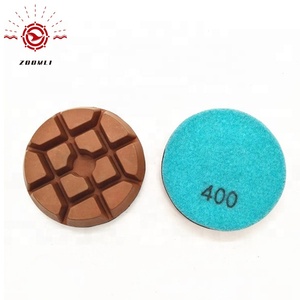
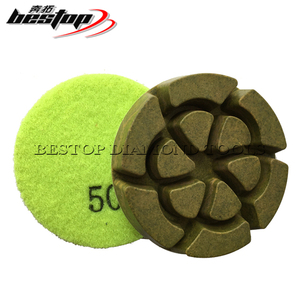
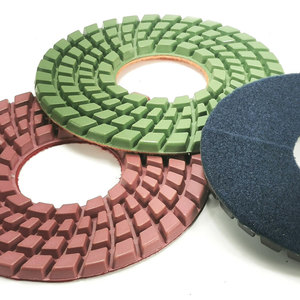
In the contemporary surface treatment industry—spanning architectural stone fabrication, structural concrete honing, and specialized countertop edge polishing—the demand for high-grade diamond tooling has evolved beyond standardized off-the-shelf components. Professional tool distributors, regional brand owners, and industrial contractors require custom resin formula engineering tailored to specific machine horsepowers, regional aggregate hardness levels, and distinct environmental regulations (such as dry cutting silica dust containment standards).
As a vertically integrated custom OEM resin pads factory and international exporter operating with over two decades of metallurgical and polymer synthesis expertise, we bridge the critical gap between raw materials processing and finished surface gloss optimization. Unlike standard trading entities or assembly distributors that re-label generic white-label stock, our manufacturing facility controls 100% of the production lifecycle—from microscopic synthetic diamond grit grading and matrix thermal stabilization to high-pressure hot-press sintering, dynamic balance tensioning, and precision hook-and-loop lamination.
Truth in Engineering & OEM Integrity: Vertical control of resin polymer chemistry, synthetic diamond crystal orientation, and sintering thermal curves allows our facility to guarantee lot-to-lot repeatability, eliminating edge chipping, premature glazing, and unexpected pad delamination on high-speed job sites.
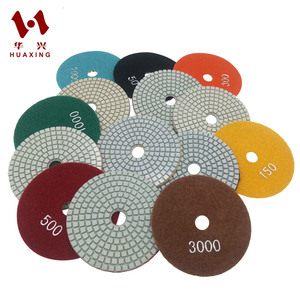
Our global supply framework operates with strategic stocking hubs across North America and Europe, supported by agile production lines equipped to handle private-label stamping, customized color-coded backings, specialized grit progressions (from coarse 30-grit stock removal up to 3000-grit ultra-buff pads), and custom geometric patterns engineered for superior swarf evacuation.
Proprietary thermosetting phenolic and polyimide resin matrix formulations tuned for specific Mohs hardness scales of granite, quartz, marble, and terrazzo.
Strict particle size distribution control utilizing monocrystalline and polycrystalline synthetic diamond grit to prevent deep random scratching (ferris wheel marks).
Full customization covering laser-etched backplate logos, custom color-coded loop pads, branded clamshell packaging, and tailor-made kit configurations.
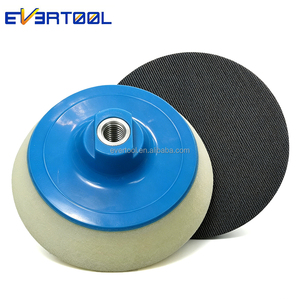
Achieving a mirror-like floor or countertop finish with high Gloss Units (GU) while maintaining an economically viable linear-meter life requires intricate tribological balance. Diamond polishing pads consist of three primary functional layers: the working resin-diamond composite matrix, the damping intermediate layer (often high-density EVA foam or micro-porous sponge), and the heavy-duty nylon hook-and-loop attachment mechanism.
During operation, as the flexible polishing pad rotates against stone or concrete under vertical downward pressure (load), friction generates localized micro-heat. The engineered thermosetting resin matrix is specifically formulated to wear away at a micro-calibrated rate. This process—known as matrix attrition—gradually exposes new, sharp synthetic diamond crystal facets at a consistent rate without allowing early dislodgement (diamond breakout) or surface glazing (where resin melts and caps over the diamond tips).
For hard, non-abrasive substrates such as dark granites and dense engineered quartz, a softer, more friable resin matrix is required to continuously release dull diamonds and expose sharp cutting edges. Conversely, for abrasive, soft materials such as green concrete or porous limestone, a highly cross-linked, thermally stable polyimide bond is synthesized to resist aggressive abrasive slurry wear and extend tool longevity.
OEM Formula Customization Factor: Heat degradation is the primary cause of resin glazing. Our proprietary nano-fillers (including copper powder, ceramic micro-spheres, and carbon nanotubes) enhance matrix thermal conductivity, allowing dry-use pads to withstand temperatures up to 350°C without burning the stone face.
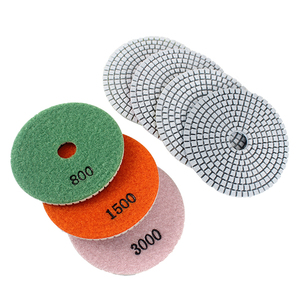
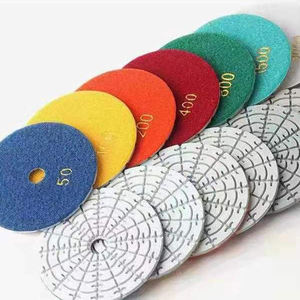
Traditional stone finishing relies on a sequential 7-step grit progression (50#, 100#, 200#, 400#, 800#, 1500#, 3000#). However, modern fabrication shops demand accelerated turnaround times. Our engineering division has pioneered advanced 3-step hybrid polishing pads that achieve comparable surface roughness values (Ra < 0.05 µm) and gloss readings (> 85 GU).
This is accomplished by incorporating multi-modal diamond grit distribution within a single pad layer—combining larger stock-removing crystals with fine polishing micro-powders inside a high-flexibility geometric channel structure that optimizes swarf removal and water flow.
To assist international procurement managers, OEM brand directors, and industrial buyers in selecting the precise technical specifications for their target markets, the following matrix outlines operational parameters across key applications:
| Pad Series / Category | Bond Formulation | Grit Range | Optimum RPM | Coolant / Use | Target Substrate | Expected Lifespan |
|---|---|---|---|---|---|---|
| 3-Step Hybrid Resin | High-Flex Phenolic + Copper Nano | Step 1, 2, 3 (50#-3000# Equivalent) | 2,000 - 4,000 | Wet / Semi-Dry | Granite, Quartz, Marble | 250 - 400 m² / set |
| Dry Concrete Restoration | Polyimide Heat-Resistant Matrix | 30# to 3000# + Buff | 1,500 - 3,000 | Strictly Dry | Polished Concrete, Terrazzo | 450 - 700 m² / set |
| Flex Fiber Buffing Pad | Non-Woven Fiber + Micro Resin | 800# to 10000# Extra Fine | 1,800 - 3,500 | Wet / Dry Dual | Marble Edges, Quartz Finish | 300 - 500 m² / set |
| Heavy-Duty Floor Resin | Reinforced Structural Resin | 50# to 1500# (12mm Thickness) | 800 - 1,800 | Wet or Dry | Industrial Concrete Floors | 800 - 1,200 m² / set |
| Turbo-Ring Large Diameter | Metal-Resin Transition Matrix | 50# to 3000# (250mm / 10") | 600 - 1,200 | Wet Industrial | Granite Slabs, Calibration | 1,500 - 2,500 m² / set |
As environmental compliance, labor efficiency, and automated manufacturing redefine the global surface preparation landscape, B2B procurement strategies for diamond resin tooling are undergoing a fundamental transformation. OEM buyers and regional importers must align their product portfolios with four decisive technological shifts:
Global regulatory bodies, particularly within the EU (REACH compliance) and North America (OSHA guidelines), are imposing stricter limits on volatile organic compound (VOC) emissions during hot-press manufacturing and dry-cutting operations. Future-ready OEM factories are transitioning toward solvent-free, eco-friendly thermosetting polymers that eliminate residual phenol emissions while improving thermal stability under high-speed friction.
Automated stone fabrication shops utilizing multi-axis CNC machines and inline robotic edge polishers require diamond resin pads with absolute dimensional stability. Variations in backing thickness or pad concentricity lead to tool chatter and uneven polish lines. Next-generation OEM pads feature high-precision injection-molded rigid backing plates with integrated dynamic dampening layers to absorb micro-vibrations under automated feed pressures.
Water runoff management on commercial construction sites has become increasingly restricted due to environmental containment rules. Consequently, contractor demand for dry concrete polishing tools is surging. The future of resin pad engineering centers on ceramic-matrix infusion and non-marking translucent resins that prevent dark transfer lines or resin burns on light-colored concrete slabs.
Large-scale rental fleets and international construction enterprises are demanding smart inventory control. OEM manufacturing trends now include embedded RFID chips or laser-etched matrix QR codes on the hook-and-loop backing, enabling automated tracking of tool wear cycles, batch traceability, and anti-counterfeiting verification.
Partnering with an established OEM manufacturer guarantees that every diamond pad leaving the facility meets rigorous industrial standards. Our production plant implements a six-stage Quality Management System (QMS) compliant with ISO 9001:2015 frameworks:
Synthetic diamond crystals undergo laser particle size analysis and toughness testing (TI/TTI index) to ensure uniform fragment geometry.
Multi-cavity hydraulic presses with computerized temperature and pressure curves ensure identical density across all segments.
Hook-and-loop backings are bonded using thermal-vulcanization adhesives, subjected to 100+ N/cm shear strength verification to prevent peeling.
By eliminating third-party markups and maintaining direct engineering oversight, we provide our OEM partners with competitive factory-direct pricing, custom formula IP protection, and guaranteed production lead times.
Direct technical answers from our engineering and export departments regarding OEM customization, minimum order quantities, and performance optimization.
Request custom sample kits, obtain factory-direct wholesale pricing, or speak directly with our Senior Product Engineers to specify your proprietary diamond pad formula.
Contact Us