How global contractors and equipment distributors calculate torque equilibrium, production square-footage per hour, and diamond bond metallurgy for commercial floor prep.
Surface preparation engineers and procurement directors continuously evaluate the mechanical mechanics between single-head rotary, triple-head planetary, and double disc concrete grinders. The dual-disc platform provides distinct physics-driven advantages that make it an indispensable asset in commercial rental fleets and contractor inventories.
Torque Neutralization & Down-Force Concentration
Unlike single-disc floor buffers or single-head grinders that impart high gyroscopic side-pull—requiring continuous physical steering correction by the operator—double disc concrete grinders operate with synchronized counter-rotating heads. Discs rotate toward each other (inward rotation) or away from each other, neutralizing torsional bias on the chassis. The machine tracks linearly in a dead-straight path, minimizing operator fatigue during grueling 10,000-square-foot warehouse shifts.
Furthermore, while massive four-head planetary polishers disperse total machine weight across a sprawling surface area, a double disc configuration concentrates substantial down-pressure onto two defined contact hubs (typically 10-inch or 12-inch diameters each, achieving a total 20-inch to 24-inch working path). This intensified head pressure per square inch enables metal-bond diamond segments and Polycrystalline Diamond (PCD) scrapers to bite deep into dense aggregates, quickly shaving curling slab curling, leveling uneven cold joints, and slicing elastomeric waterproofing membranes cleanly without hydroplaning.
Engineered Tooling & Equipment Lineup
Recommended Double Disc Grinding Configurations & Tooling Systems
A grinding machine is only as productive as the diamond segments bonded to its rotor plates. Diamond Vantage manufactures complete matched systems engineered for high production, low drag resistance, and optimized thermal dissipation.
DV-Dual 2200 Electric Double Disc Grinder
Industrial 230V/460V 3-phase, 10 HP motor with variable frequency drive (VFD). Dual 11-inch counter-rotating plates, integrated OSHA-compliant dual vacuum ports, and quick-tilt wheel carriage for fast tooling swap-outs.
Dual-quarter PCD inserts with sacrificial tungsten carbide wear-bars. Engineered specifically for double disc plates to tear through heavy epoxy mortar, thick urethane coatings, bitumen, and black mastic adhesives without smearing.
Proprietary 3D diamond array technology ensuring exact crystal placement. Delivers up to 40% faster stock removal on hard-troweled 6,000+ PSI commercial slabs while maintaining uniform wear and eliminating micro-gouging.
Fast-track transitional pads designed for double disc machines crossing over from aggressive metal-bond leveling into honed polished concrete. Blends scratch patterns seamlessly from 50 to 400 grit.
Rain-damaged slabs, chalky concrete, pre-leveler leveling, high sand content.
All Substrates (Mastic, Urethane, Polyaspartic)
PCD Scraper + Wear-Bar
Quarter / Half Round PCD
CSP 3 – CSP 4
Demolition, parking deck membrane removal, heavy carpet adhesive stripping.
Engineering Principle: Always match bond in inverse relation to slab hardness. A soft bond erodes rapidly to expose new diamond points against hard aggregates, while a hard bond locks crystals in place against abrasive sands to maximize square-foot tool life.
Strategic Sourcing Intelligence
Future Procurement Trends for Double Disc Grinders (2026–2030)
As procurement teams, national rental chains, and infrastructure contractors modernize their surface preparation fleets, equipment selection is shifting from simple motor-power comparisons toward total life-cycle cost, regulatory safety compliance, and digital uptime analytics.
01
High-Efficiency 480V Inverter Drives
Procurement requests are rapidly pivoting toward variable frequency drive (VFD) electronic controllers that accept dual input voltages (208–240V 1-phase or 480V 3-phase). This allows contractors to utilize residential jobsite power without tripping breakers while running high-torque commercial passes on industrial sites.
02
Stringent Respirable Silica Mandates
OSHA 29 CFR 1926.1153 in the United States and equivalent EN standards across Europe mandate airtight containment. Next-generation double disc grinders feature engineered floating dust cowls with multi-point labyrinth brush seals and integrated dual 3-inch camlock vacuum ports to maintain zero-leakage negative pressure.
03
Universal Magnetic Tooling Standards
Traditional bolting patterns require 15 to 25 minutes of downtime per disc change. Modern fleet buyers require magnetic quick-slide toolholders compatible with standard Redi-Lock, Lavina, or trapezoid bases, slashing segment changeover to less than two minutes across all job phases.
04
IoT Telemetry & Wear Monitoring
Equipment leasing companies and tier-1 infrastructure contractors now favor machines integrated with Bluetooth/cellular telemetry. Real-time metrics track motor thermal load, disc rotational hours, vibration exposure (HAVS), and scheduled maintenance intervals remotely.
Optimize Your Surface Preparation Fleet Today
Consult with Diamond Vantage application engineers to configure custom grinding tooling matrices, volume container pricing, and private-label programs.
Technological Evolution: From Direct-Drive to Precision Helical Dual-Disc Engineering
Historically, early double disc concrete grinders relied on raw belt drives and rudimentary grease boxes that suffered from high friction losses, frequent belt slippage, and inconsistent rpm between the twin spindles. Today's commercial-grade double disc machines have transformed into high-precision, low-maintenance mechanical powerhouses.
Key Mechanical Breakthroughs Include:
Hardened Helical Gear Transmission: Heavy-duty oil-bath gearboxes replace belts, providing 98% direct torque transfer with zero slip during aggressive stock removal.
Independent Flex-Coupling Spindles: Multi-axis shock mounts allow each grinding disc to float slightly over slab contours, preventing gouging and ensuring 100% segment contact over high spots.
Anti-Vibration Iso-Mount Handles: Meets European Directive 2002/44/EC for Hand-Arm Vibration Syndrome (HAVS), enabling safe 8-hour continuous operator duty cycles.
Integral Water Mist Manifolds: Built-in solenoid valves regulate wet-grinding cooling without over-saturating the floor, prolonging diamond life on abrasive slabs.
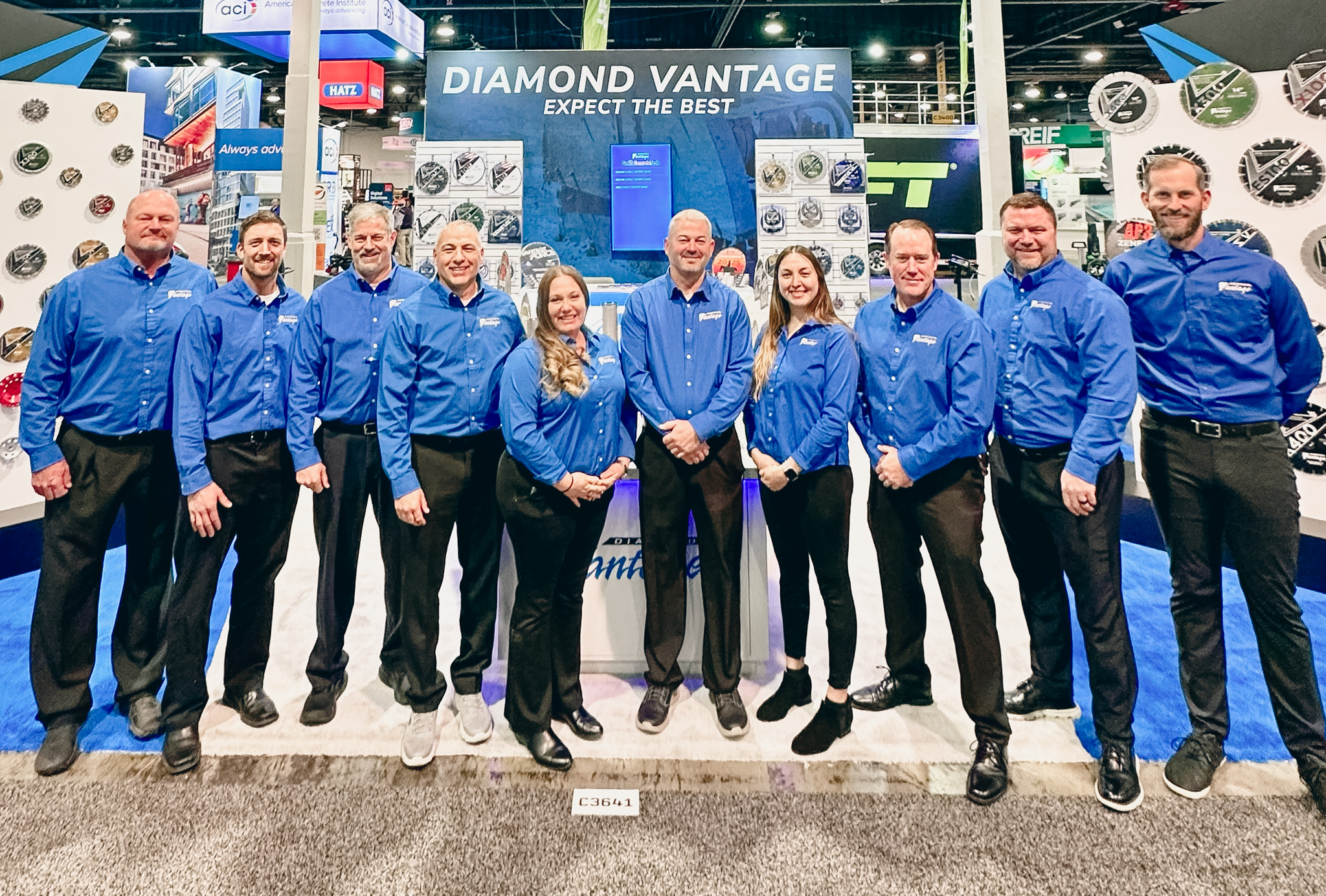
The Diamond Vantage surface prep engineering team at World of Concrete
20+Years of Manufacturing
The Manufacturer Difference
Why Global Importers & Contractors Trust Diamond Vantage
Unlike equipment brokers and trading companies that resell catalog goods, Diamond Vantage has been a true manufacturer since 2003. We formulate, test, hot-press sinter, and inspect 100% of the diamond tooling we manufacture.
Why choose a double disc concrete grinder over a single disc or planetary machine?
Double disc concrete grinders feature dual counter-rotating discs that completely neutralize torque pull. Unlike single-disc machines that physically jerk sideways, double disc units track straight with minimal user strain. Compared to wide 3- or 4-head planetary grinders, double disc grinders concentrate maximum down-force over a compact 20-to-24-inch path, delivering significantly faster aggressive leveling on uneven expansion joints, high spots, and mastic removal.
What production rate (sq. ft. per hour) can be expected from a commercial double disc grinder?
Production rates depend on slab compressive strength (PSI), aggregate hardness, and tooling grit. In typical commercial operations: adhesive and thin-set scraping with PCD blocks averages 400 to 750 sq. ft./hr; rough leveling (16/20 grit metal bonds) averages 300 to 500 sq. ft./hr; and secondary smoothing (60/80 grit) reaches 600 to 1,000 sq. ft./hr when paired with an industrial continuous-pulse vacuum extractor.
How does the aggregate hardness on the Mohs scale dictate diamond bond matrix choice?
Always follow the rule of opposites: Hard aggregate (Mohs 7–9: quartz, river gravel, trap rock) creates non-abrasive dust that cannot erode hard metallic binders; it requires an ultra-soft cobalt/copper bond to rapidly shed spent diamonds and expose sharp cutting edges. Soft, abrasive concrete (Mohs 2–4: high sand, limestone, green slabs) produces powdery abrasive dust; it requires an ultra-hard tungsten carbide alloy bond to resist premature erosion.
Can double disc grinders achieve International Concrete Repair Institute (ICRI) CSP profiles?
Yes. Equipped with coarse 16/20 grit segments or PCD scrapers, a double disc grinder creates a CSP 3 to CSP 4 profile (ideal for self-leveling underlayments, high-build epoxy, and broadcast quartz systems). Equipped with 60 to 120 grit diamond segments, it produces a CSP 1 to CSP 2 profile (tailored for thin-film sealers, stains, and moisture mitigation primers).
What dust collection CFM is mandatory for OSHA Table 1 crystalline silica compliance?
OSHA crystalline silica standard 29 CFR 1926.1153 requires grinders with 20+ inch working diameters to be coupled to an industrial dust collector delivering a minimum of 25 CFM per inch of grinder diameter with HEPA filtration (99.97% efficiency at 0.3 microns) and automated filter reverse-pulsing. For a 22-inch double disc grinder, a minimum airflow of 550 CFM is required.
Does Diamond Vantage offer private labeling and custom diamond segment engineering?
Yes. Diamond Vantage provides turnkey OEM/private label manufacturing for national distributors, rental chains, and surface prep equipment OEMs. We design custom segment geometries (trapezoid, button, bar, directional arrow), formulate proprietary matrix alloys, and apply custom laser-etched branding and private packaging.
Direct Manufacturer Access
Procure Double Disc Grinding Systems Direct
Contact Diamond Vantage engineering and sales teams for certified equipment specifications, volume distributor discounts, and sample testing programs.